
Ion beam polisher

The 6NAPSE Group uses an ion beam polisher to prepare its samples before SEM analysis.
The ion polisher creates an extremely smooth and clean surface, essential in order to obtain precise images or data.
An ion polisher for the preparation of our samples
Our laboratories use the ion polisher to prepare samples before analysis by scanning electron microscope (SEM). Our laboratory uses 2 methods: the first consists of polishing the sample without resin and the second consists of putting the sample under resin to be able to better see the coating layers that we are trying to observe. Advantage of the ion polisher:- High precision: ideal for sensitive samples.
- Uniformity and quality of the surface: completely smooth, uniform…
- Versatility: it can be used on a wide variety of materials.
- Suitable for nanometric scales: it can thin a sample to nanometric thicknesses.
How does the ion polisher work ?
Ion polishing is based on the principle of sputtering. An ion beam is accelerated and directed towards the surface of the material to be polished. The impact of the ions causes the ejection of atoms from the surface, which eliminates irregularities and defects.
The process takes place in a vacuum chamber, which allows the energy and angle of incidence of the ion beam to be precisely controlled. By adjusting these parameters, it is possible to control the speed of material removal and the quality of the resulting surface.

Paper before ion polishing
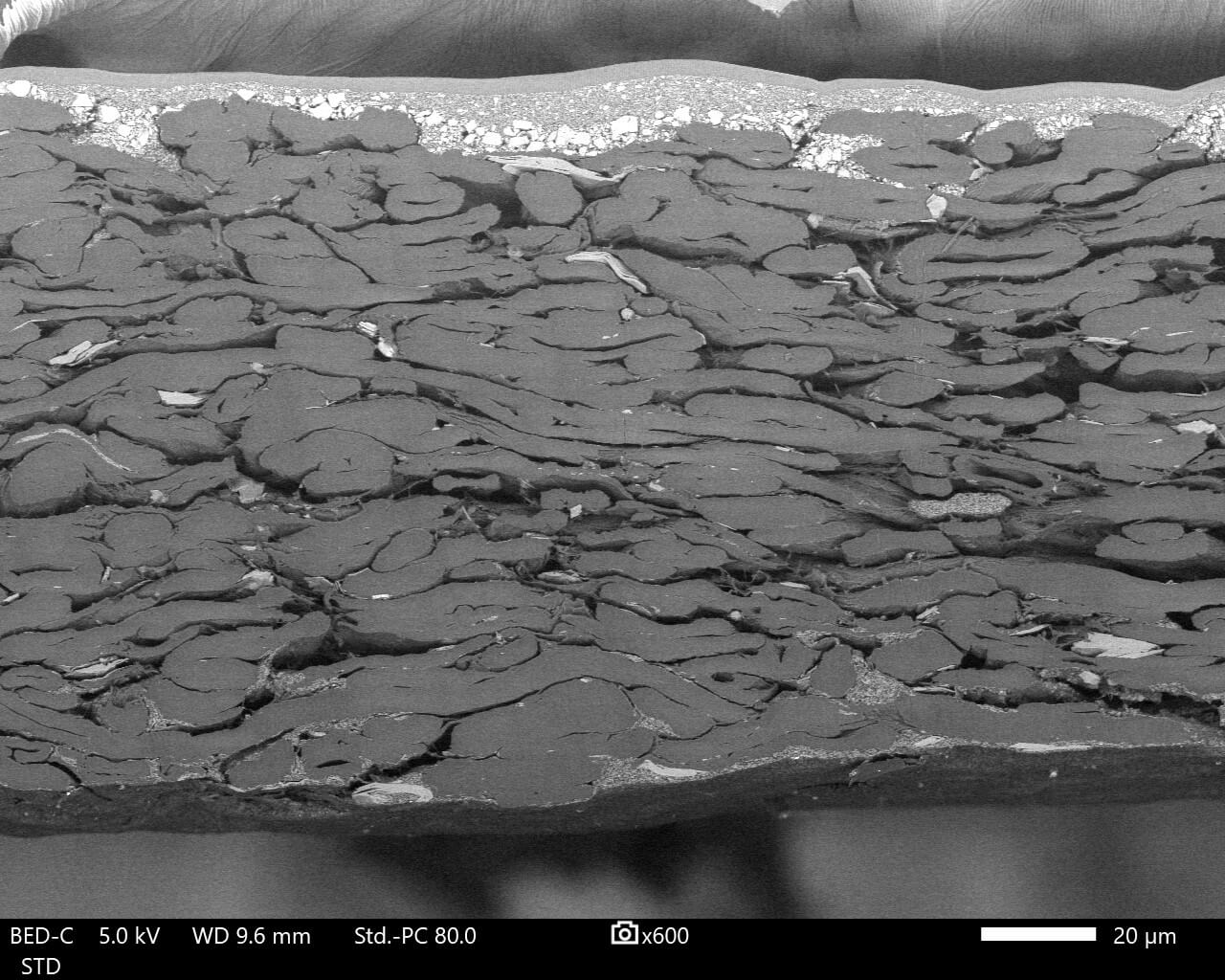
Paper after ion polishing
Conventional polishing VS Ion polishing
A conventional polish will use abrasive, mechanical or chemical tools to remove surface material. It will be less precise and may leave scratches. It is suitable for a wide range of materials, but the results may vary depending on the hardness and sensitivity of the material. It may not be sufficient for applications requiring nanometric precision.
For more information, contact our teams!